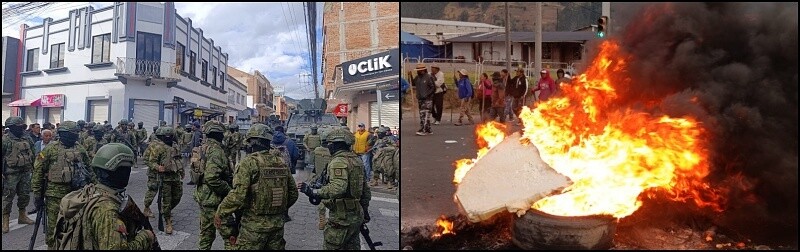
On Sunday, November 16th, a referendum was held in Ecuador—a popular consultation through which the government of Daniel Noboa seeks to consolidate his geopolitical strategy, built in conjunction with the government of Donald Trump. The four questions it posed were: to allow foreign military bases, eliminate public financing for political organizations, reduce the number of assembly members, and convene a Constituent Assembly. In all cases, the “NO” vote won by a wide margin of 60%, demonstrating a clear popular rejection of the colonial policies this government seeks to implement. This referendum is also a vote of no confidence in the policy of the Noboa government, in the way he has attempted to concretize his exercise of power throughout his previous and current mandate, and above all, in the authoritarianism he has tried to implement in Ecuador in recent months. Nevertheless, despite the expression of popular will, the geopolitical strategies of Noboa—based on U.S. interests—remain in force. In this line, one of the commitments encouraged by both the current and previous Ecuadorian governments is the mining agenda. Specifically, the Noboa administration has reopened the mining cadastral register, another of the great interests of the IMF and extractive policies at the continental and global level, anchored to both his geopolitical strategy and the U.S. geopolitical strategy. By using the legal figure of terrorism financing, not only individuals but also organizations were blocked. This constitutes a new coercive measure that clearly violates individual and collective rights and has been added to the entire repressive and dissuasive strategy practiced by the incumbent government. In addition to all this, President Noboa has focused on an eminently media and marketing strategy, installing narratives that position his account of the facts, by discrediting and delegitimizing any counter-narrative to it. However, with the results of the referendum, the Ecuadorian people condemn this way of doing politics as a daily practice and put a stop to the government. In this context, and with the experience of the last two social uprisings of October 2019 and June 2022, as well as the latest national strike of September 2025, social movements must evaluate strategies that allow for the consolidation of a struggle front against the onslaught of neoliberal governments and the geopolitical recipes outlined by multinational organisms across the continent. The organized people must determine the steps that will lead to the strengthening of social organizations, generating new ties and bonds beyond borders, to be able to face this new capitalist strategy in Ecuador and all of Latin America. We can read these results as a stop to the government's intention to roll back rights conquered over decades by social organizations, indigenous movements, and the Ecuadorian people in general. The Ecuadorian government continues, in addition, to implement the IMF's recipes to the letter, despite the resistance of the territories. Thus, some cantons of the country are among the most violent places in the world. The rates of violent deaths per 100,000 inhabitants per year even surpass those of Mexico or Brazil, territories historically traversed by these dynamics. In this way, the State has been exercising different mechanisms of pressure and repression against social organizations, specifically in the territories with the presence of the indigenous and peasant movement, where it has sought to strengthen mining and oil extraction plans, encountering firm resistance from rural sectors, which have been violently repressed. As an example of this, we have the case of Palo Quemado in the province of Cotopaxi, where there was strong opposition to the unconsulted presence of a mining company, as well as to the establishment of a supposed consultation as a mechanism to legitimize the entry of a Canadian company. Since the presence of mining concessions is in many cases precisely linked to the presence of organized crime groups, we can say that this violence is also linked to drug trafficking. There are criminal groups such as “The Wolves,” for example, that control mining concessions, which is a very lucrative business and is part of the continental extractivist strategy, making it impossible to unlink the issue of drug trafficking from the extractive frontier. In Ecuador, all recent governments have made pacts with organized crime groups, as is the case of the current government with The Chaneros, and the previous one with the Albanian mafia. This resistance was repelled in an absolutely violent manner, leading to the prosecution of seventy people for the supposed crime of terrorism. In this context, the 2025 national strike marks a turning point in the repression strategy on the part of the Noboa government, which violently repressed the demonstrations, militarizing entire cities. This is the case of the capital itself, Quito, as well as cities in the northern sierra of the province of Imbabura, such as Otavalo, where the deployment of more than 7,000 police and military personnel in cities with low population density demonstrates the disproportionate repressive mechanism practiced by the Noboa government, devised based on guidelines marked by the cooperation it maintains with the Americans. To all these repressive strategies, a new financial strategy has been added, which has consisted of the blocking of bank accounts of social leaders, technicians, lawyers, among other popularly elected authorities, leaders of the indigenous and peasant social movement, which has happened since the month of September. Through these groups they have a certain territorial control, but of course they do not control them in their entirety. The government of the U.S.