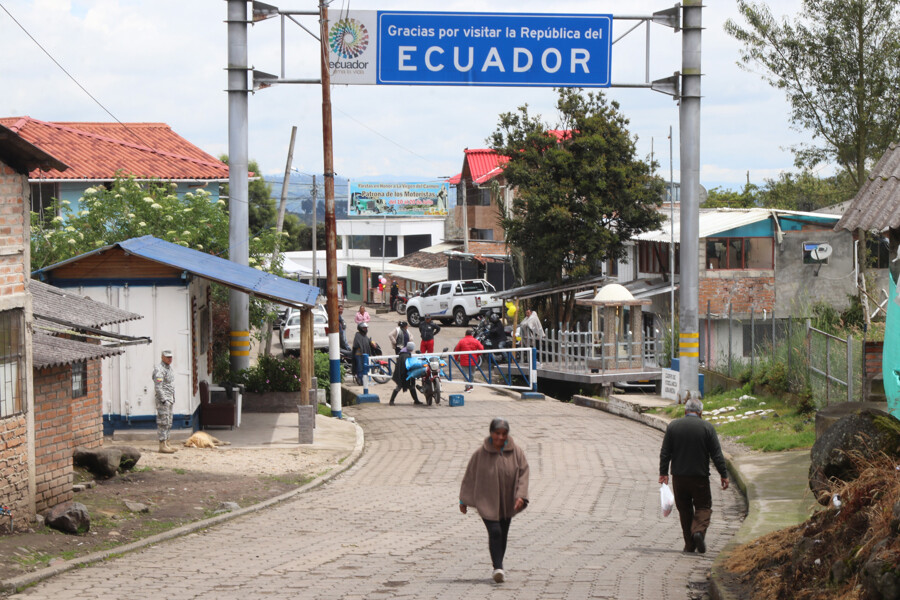
Experts have warned that the security crisis on the border between Colombia and Ecuador, exacerbated by the reconfiguration of drug trafficking following the pandemic and the advance of organized crime in the latter country, cannot be resolved with unilateral commercial measures. This warning came after President Daniel Noboa announced a 30% tariff on Colombian imports.
According to Laura Bonilla, deputy director of the Peace and Reconciliation Foundation (Pares), the analysis must start from the premise that drug trafficking is not a single group or cartel, but a transnational market with multiple actors and links in a chain distributed across different countries. She explains to EFE that during the pandemic, there was a significant alteration in the routes and methods of cocaine export, which led to criminals reorganizing.
While Colombia consolidated itself as a producer of the alkaloid, in neighboring countries like Ecuador, drug traffickers began to set up key processing phases, including its transformation into cocaine hydrochloride. This reordering, the analyst warns, increased the demand for violent services in Ecuador, generated greater circulation of illegal money, and accelerated the expansion of local organized crime.
To this is added, she adds, the growth of criminal control over the Ecuadorian prison system, one of the factors that has most influenced the deterioration of that country's internal security, where riots have left more than 500 dead since 2021.
"Hasty Decision"
In the realm of international relations, analyst Gabriel Clavijo, a professor at the Nueva Granada Military University, acknowledges that Ecuador is empowered, by the principle of the free self-determination of States, to adopt unilateral decisions in foreign policy.
However, he warns that this right must be exercised with prudence, tact, and strategy, especially when dealing with neighboring countries with a close historical relationship. In his opinion, Noboa's decision to announce a 30% tariff on products imported from Colombia, alleging that the country does not cooperate enough in the fight against drug trafficking, was "hasty" and did not adequately measure its diplomatic and regional consequences.
The expert told EFE that the measure responds, in part, to an attempt to redirect the internal debate when the results of his hard-line policy against criminal gangs and the impact it has had on the government's popularity are being questioned.
"Limits of International Discourse"
Clavijo also questions whether the Ecuadorian Executive has singled out Colombia for the way it faces drug trafficking, considering it an overreach of diplomatic discourse. "Countries cannot opine on the internal policy of other States on security matters," he maintains, recalling that this type of accusation increases regional tension and hinders the necessary cooperation to face common threats.
In colloquial terms, the analyst adds, "dirty laundry is washed at home," an unwritten but widely accepted principle in international relations.
Colombia Defends Its Management
In the face of Ecuador's accusations, the Colombian government has defended its management in border security and bilateral cooperation with data from the Ministry of Defense showing that joint operations and information exchange between the two countries have allowed for a significant impact on transnational criminal economies.
In the fight against drugs, seizures of cocaine hydrochloride in border municipalities with Ecuador went from 86,786 kilograms in 2023 to 132,354 in 2024 and rose to 195,862 in 2025, representing a sustained increase in seizures, attributable to a greater operational effort by the Colombian public force.
Authorities also highlight that the eradication of illicit crops has been concentrated in departments like Putumayo and Nariño, bordering Ecuador, as well as the dismantling of transnational criminal organizations through 91 joint coordinations that resulted in 26 operations, 39 deportations, 25 judicial arrests, and the rescue of seven people.
Regional Cooperation
For the experts, the way out of the crisis lies in reactivating bilateral mechanisms, strengthening police and intelligence cooperation, and assuming a regional vision of drug trafficking and organized crime, phenomena that transcend national borders.
In this context, they warn that measures like the tariff imposed by Ecuador can deepen the political distance without generating real impacts on border security, at a time when both countries face common challenges in one of the most sensitive areas of the Andean region.