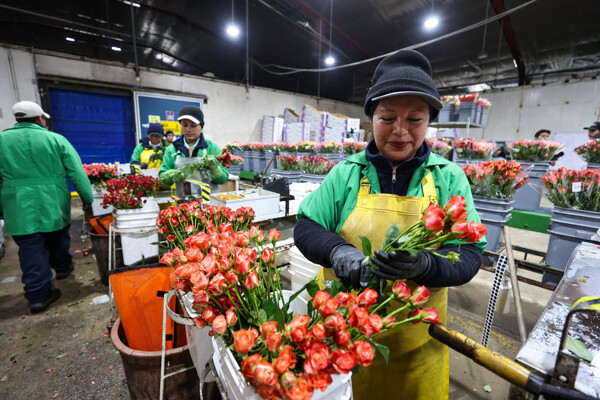
According to calculations by the national association of flower producers and exporters (Expoflores), revenue from the sale of Ecuadorian flowers for the 2026 Valentine's Day season will fall by around six million dollars due to tariffs imposed by the United States and climate variations. In the 2025 season, sales were around 282 million dollars, while they estimate revenue of between 274 and 276 million dollars for this year's Valentine's Day season. "I don't think we'll pass 280 million dollars," he said, noting that the decline was influenced by the 15% tariff imposed last year by the Donald Trump government, which was added to the 6.8% they already paid. In contrast, they project a growth of between 3 and 3.5% in export volume, increasing from 37,000 tons in 2025 to about 39,000 tons via air and sea this season, which has seen two production peaks due to climate variations, he indicated. Ecuador, whose main markets are the U.S., Canada, and Europe, is the world's third-largest flower exporter after the Netherlands and Colombia.
Air Cargo The airline Avianca Cargo, which transported 18,000 tons of flowers from Colombia and Ecuador to the U.S. for Valentine's 2025, plans to increase this season to 85 cargo flights for flowers from Ecuador, up from 69 last year. Ramón Miró, president and CEO of Quiport corporation, the firm managing Mariscal Sucre Airport in Quito, calculates a growth of around 6% in exports from that point compared to last year. "It's spectacular because 2025 was already a record year," he told EFE. During a visit to the Mystic Flowers farm in Cayambe, near Quito, Miró recalled that in the last season, almost 29,000 tons left from that terminal, transported in 534 flights. He added that from January 20 to February 1 of last year, they moved 17,600 tons in 332 flights from 16 cargo airlines, mainly to Miami and Amsterdam. "The season has been a bit cyclical. Ecuador has 6,200 hectares of flower production, with about 1,300 farms. The main destinations for Ecuadorian flowers are the large logistics cargo distribution hubs in the U.S. and Europe, with Miami and Amsterdam standing out, from where they are distributed to all markets globally."
Quito Airport Growth Quiport recalled that the cargo operation at Quito airport has shown sustained growth, allowing it to rank fifth in Latin America and the Caribbean in terms of annual cargo volume moved. Last year, it closed with a total of 407,240 tons of cargo transported in the categories of exports, imports, and domestic cargo. Regarding air export performance, 336,480 tons were exported from Quito, registering an 11.2% growth compared to 2024. "When the season started, the flowers were not ready, then a lot of flowers came in, then there was a slight slowdown, and now there is a very, very high volume," he said. The Valentine's Day season represents 30% of annual sales of flowers from Ecuadorian farms, where the floricultural sector employs 120,000 people.